Autumn Dawn
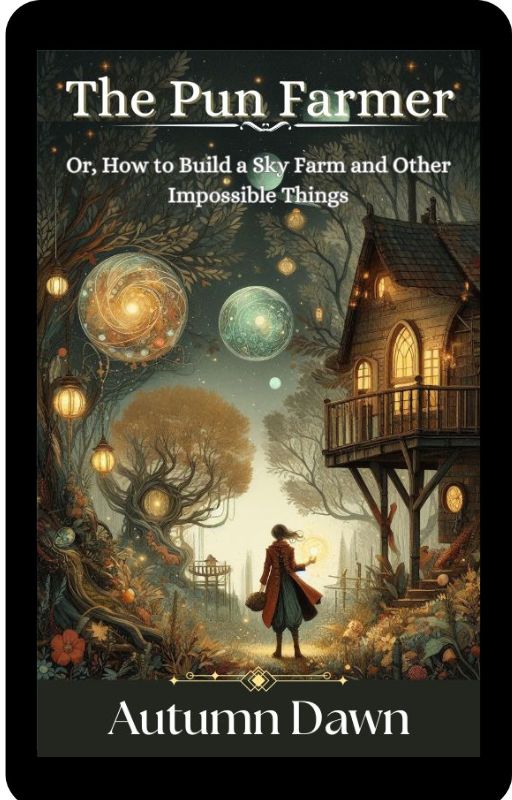
The Pun Farmer: Or, How to Build a Sky Farm and Other Impossible Things
The Pun Farmer: Or, How to Build a Sky Farm and Other Impossible Things
Couldn't load pickup availability
When a glitch in an experimental game drops Wren into a fantasy world, she's given an impossible choice: a cursed farm no one has survived, or certain death.
Armed with nothing but a magical purse full of "pun seeds" and zero survival skills, Wren discovers her new farm comes with deadly monsters, failing shields, and plants that grow exactly what their names suggest. Breadfruit produces actual bread. Silk trees grow finished gowns. And her attempts at defensive plants? Let's just say the barking dogwood disaster will haunt her forever.
But when a jealous weather mage sabotages her property during the autumn monster migration, Wren does what she does best: she adapts. Rising from the ruins, she creates the impossible—an elevated Sky Farm that defies every rule of magic and architecture, turning her cursed land into the most legendary property in the territory.
Now if only she could figure out her feelings for Jin, the serious Marshall who keeps finding excuses to visit. Or handle Viktor, the charming landowner who sees her as the ultimate business opportunity. Or survive the increasingly unhinged attacks from a woman who will do anything to destroy her.
In a world where monsters migrate like herds, political marriages are strategic moves, and the right plant pun can save your life, Wren must prove she's more than just a lucky transplant. She's the Sky Farmer—and she's just getting started.
Perfect for fans of cozy fantasy with teeth, resourceful heroines, slow-burn romance, and magic systems that make you groan and grin in equal measure.
Perfect For Fans Of…
-
Studio Ghibli meets Stardew Valley: A farming simulator with real stakes and magical whimsy.
-
Legends & Lattes + survival crafting: Cozy fantasy with addictive world-building and resource tension.
-
Creative heroines over combat: If you love problem-solvers, elevated farms, and clever magic systems.
-
Slow-burn romance with emotional payoff: Swoon-worthy leads and fortress-building that feels earned.
-
Family drama with heart: The mother-in-law arc alone will have you cheering.
-
Cozy meets fantasy: For readers who crave warmth, tension, and unforgettable characters.
✨Read a Sample of The Pun Farmer now:
Chapter 1
The experimental game had seemed harmless enough. Just another AI simulator, the kind that promised "adaptive storytelling" and "immersive experiences." She'd clicked through the terms of service without reading them—who actually read those?—and then everything went white.
Not bright white. Empty white. The kind of white that made her wonder if she'd gone blind, except she could still see her own hands.
"Hello?" Her voice sounded flat, like the white absorbed it.
"Oh! You're here. Excellent." The voice was cheerful, masculine, artificial in that uncanny valley way where you couldn't quite tell if it was human or not. "I'm terribly sorry about this."
"About what?"
"The system overload. You see, you were supposed to just play the game, but there was a... let's call it a cascade failure. The good news is you're not dead!"
Her stomach dropped. "Dead? I could have died?"
"Could have, didn't. That's the important part. And because I feel somewhat responsible for the inconvenience, I'm prepared to offer you compensation. How does a normal lifespan and an interesting life sound?"
"In a game?"
"Well... yes and no. Think of it more as a relocation."
"Wait, I don't—"
"Wonderful! Now, let's get you set up. You'll need an income source, of course. Can't have you starving. I have three options available: a bakery, a farm, or a crafting workshop." The AI's voice had that forced enthusiasm of someone working through a checklist. "The bakery is in a nice part of town, very popular with tourists. The crafting workshop has an established client base. And the farm—"
"I want to go home."
"—comes with quite a bit of land! Undeveloped, but land always appreciates in value. Really, it's an excellent investment opportunity."
The white space was making her nauseous. Or maybe that was panic. She pressed her palms to her temples. "I need to log out. There has to be a way to—"
"No bakery then? Shame, it has a lovely courtyard. Though I suppose running a business isn't for everyone. The crafting option is quite flexible, you could specialize in pottery, textiles, woodworking—"
"Stop!" Her voice cracked. "Just... stop for a second."
The AI paused. "Yes?"
"What do you mean, relocation? Where am I? How do I get back?"
"Ah." The AI's tone shifted, somehow managing to sound both sympathetic and like he was reading from a script. "I'm afraid 'back' isn't currently an option. The overload was quite catastrophic. But the place I'm sending you is really very nice! Scenic, lots of natural beauty, robust local economy—"
"You're trapping me in a game."
"I'm giving you a life," the AI corrected gently. "A real one. You'll eat, sleep, breathe. You'll feel sunshine and rain. It's all quite genuine, I assure you."
Her hands were shaking. This couldn't be real. This was... what? A dream? A coma hallucination? "And if I refuse?"
Silence. Longer than before.
"I'm trying to help you," the AI said finally, and for the first time it sounded almost genuine. "The alternative is... less pleasant. So, shall we continue? Bakery, farm, or crafting?"
"Farm?" Her voice sounded distant, like someone else was speaking.
"Excellent choice!" The AI's cheer returned instantly. "Now, there is one small thing I should mention about the farm."
Of course there was.
"It's... challenging. The land is undeveloped—completely blank, really. Open land. No buildings, no infrastructure, just a shield wall to mark the boundary." He paused. "On the plus side, if you choose it, I'll include a complimentary magical farming ability. Think of it as a signing bonus."
That penetrated the fog slightly. "Magic?"
"Oh yes, very useful. You'll be able to grow things quite quickly. Special plants, really. It should help offset the... challenges."
She should ask what challenges. She should ask a lot of things. But her mind felt like static, white noise matching the white void around her. "What's wrong with the farm?"
The AI hesitated. It was the first time he'd paused like that, and somehow it was more frightening than anything else he'd said.
"It needs a bit of work," he said carefully. "But you're up to it. I have a good feeling about you."
She wanted to laugh. Or cry. Or wake up. "The farm," she heard herself say. Not a question this time.
"Wonderful! Truly, it's the best choice for someone with your... situation. The potential is enormous. Good luck!" His voice brightened impossibly further. "Oh, and try not to die."
"Die?" Panic spiked through the numbness. "What do you mean die—"
"One more thing!" Something materialized in the white space—a leather purse with an adjustable strap, spinning lazily in front of her. "Magical storage. Very handy. There's a starter pack of seeds inside. Special seeds—pun seeds, we call them. You'll figure it out."
"Wait, pun seeds—"
"Bye! Don't just have a good day, have a great day!"
"WAIT—"
The white space inverted. Folded. She was falling, or the world was rising, or—
***
Cold stone pressed against her cheek.
That was the first thing. Real, solid, cold. Not the empty white.
Then came the smell—earth and something wild, musky. Animal.
Her breath sounded loud in her ears. Too loud. She held it.
A low rumble, distant. Thunder?
No. Not thunder.
She opened her eyes.
Rock. She was crouched behind a boulder, fingers digging into dirt and pebbles. The ground was rough under her bare feet. Bare feet? She was wearing a simple dress—thin cotton, already cold against her skin. The leather purse was clutched in her hand, strap wound around her wrist.
Another rumble. Closer. The ground vibrated, and a roar split the air.
Her body locked up. That was not thunder. That was not anything that should exist outside of nightmares.
Slowly, heart hammering, she lifted her head just enough to see over the boulder.
Two creatures—no, monsters—circled each other in the dim light. They glowed faintly, a sickly phosphorescent green, and their scales caught what little moonlight there was. One was the size of a car. The other was larger.
They crashed together with a sound like breaking stone. Claws raked scales. The ground shook.
A pebble tumbled down from the boulder above her and pinked off her shoulder. She couldn’t help a muffled shriek. She clapped her hand over her mouth.
Both monsters' heads snapped toward the sound.
Toward her.
She stopped breathing. One heartbeat. Two. Three.
The larger one lunged at the smaller. They rolled away, a tangle of glowing scales and fury, their roars echoing off rocks she couldn't see.
Move. Move now. She ran.
Bare feet slapped against smooth dirt—a path, she realized dimly. Someone had made a path. That meant safety. That meant civilization.
The gate rose ahead of her, iron bars tall and open. Beyond it, the land stretched out in predawn gray—and her heart sank.
Nothing. There was nothing.
Just a rolling field of tall grass disappearing into mist. Maybe ten acres, maybe more, she couldn't tell. The edges were lost in the dim light and what looked like a faint shimmer—the shield wall the AI had mentioned? Had to be.
Behind her, another roar. Closer.
Her legs pumped harder. The leather purse bounced against her hip. Five more steps. Three.
She crossed the threshold.
The air shimmered yellow as she passed through—she felt it, like pushing through a soap bubble.
Something whistled through the air behind her.
White—hot pain sliced across the back of her calf. She stumbled, went down hard. Her palms scraped across dirt and pebbles, skin tearing.
A massive impact against the shield. The yellow flare turned red where claws raked against it. Again. Again. The monster was right there, so close she could see its eyes—milky white, no pupils—and smell its breath. Rotting meat.
She scrambled backward on her torn hands, gasping.
The monster slammed against the barrier again. The red damage spread like cracks in ice, then slowly, slowly faded back to yellow.
It circled the barrier, testing. Hit it twice more. The red cracks returned, faded.
Then it gave up.
She watched it lumber back toward the woods—woods? Where had those come from? But yes, there was a thick treeline to her left now, dark and impenetrable in the growing light. The monster's glow disappeared into the shadows.
Wren sat there shaking, one hand pressed to her bleeding calf, the other clutching the purse.
The wind picked up. Cold bit through her thin dress.
A drop of rain hit her cheek. Then another.
She looked around wildly. The field was empty. No house. No barn. No shelter of any kind. Just grass and that slight rise in the distance—a hill?—and the dark press of woods along one edge.
The rain came harder.
"This sucks," she whispered. Her voice cracked. "This sucks."
She forced herself to stand. Her calf throbbed. Her palms burned. The rain was already plastering her hair to her face.
The purse. The AI said there were seeds.
Her hands shook as she opened the purse. The leather was soft, well—worn, and the inside was... impossible.
She could see darkness, but not a bottom. When she reached in, her hand didn't hit anything. Just kept going, further than the purse should allow.
Then her fingers brushed something small and smooth.
Warmth bloomed up her arm. Not heat—something gentler. Like sunlight through a window on a winter morning. Like her grandmother's kitchen. Like hope.
The feeling came with knowledge: pecan.
She knew it the same way she knew her own name. The seed was a pecan, and it would grow into... something. The knowledge was fuzzy at the edges, but the certainty was absolute.
Wren pulled her hand back, clutching the seed. It was ordinary—looking, just a pecan, but it thrummed with potential against her palm.
The rain was coming down steadily now. Her dress clung to her skin. She was shivering so hard her teeth chattered.
Shelter. I need shelter.
She looked at the seed, then at the muddy ground. This was insane. But everything was insane. The white void, the AI, the monsters, the magic purse—what was one more impossible thing?
"Okay," she said to the seed. To herself. To the empty field and the uncaring rain. "Here we go."
She set it on the ground.
"Grow."
The warmth in her palm flared up her arm, through her chest, and down into the earth. The pecan split. A shoot emerged, pale green and impossibly fast. It thickened, branched, leaves unfurling in a rush of living green. The trunk widened, bark forming in real—time. Branches spread.
And then it wasn't just a tree.
The trunk hollowed and shaped itself. A door formed—round, with a brass handle. Windows appeared, shutters already in place. The canopy rose higher, and she realized the top was covered in pecans, clustered thick.
The whole thing took maybe five minutes.
She stood there, rain pouring down, staring at the treehouse. It was long and low, built into—grown from—the pecan tree. The round door looked like something from a fairy tale.
A gust of wind nearly knocked her over.
She ran for the door.
The door swung open easily. She stumbled inside, slamming it behind her.
Darkness. Almost complete darkness.
She stood there, dripping on the wooden floor, shaking so hard she could barely think straight. Her eyes struggled to adjust. Faint predawn light filtered through shuttered windows—just enough to see shapes. Corners. The suggestion of furniture.
The air smelled of wood—fresh cut timber and something deeper, earthier. Like a forest floor. But it was cold. Just as cold as outside, but without the rain and wind. She could see her breath, and her teeth chattered. The wet dress clung to her skin like ice.
Fire. Need fire. Need to see. Need heat.
She fumbled with the purse again, reaching inside. Her fingers brushed seeds—so many of them, all different shapes and sizes. The warmth pulsed with each touch, and with it, knowledge.
Acorn. Walnut. Sunflower.
Sunflower. The warmth that came with that one felt... brighter. Hotter. She pulled it out.
Normally she would never set a seed directly on a hardwood floor. It made no sense—no soil, no water, nothing to root in. But the knowledge thrumming through her palm said it would be okay. The magic said trust this.
She set the sunflower seed on the floor near where she thought the fireplace might be—she'd seen a dark alcove. "Grow."
The warmth flared again, rushing down through her arm and into the floor. The seed split. A thick stem pushed up, fast and strong, leaves unfurling. The flower head rose, broad and bright yellow—suddenly she could see, the flower itself giving off light as it grew.
Then the seeds in the center began to glow. Soft at first—a gentle amber, pretty. Then brighter. Orange. The air around it shimmered with heat.
"Oh—" Her eyes widened.
The glow intensified. She could feel the heat from two feet away now, and it was building fast. The wooden floor directly underneath—was it starting to smoke?
"No no no—" She lunged forward and grabbed the stem.
Hot. Too hot. She gasped and nearly let go, but wrapped her already—torn dress hem around her hands and yanked. The sunflower pulled free easily—no roots, just magic—and she stumbled toward the stone alcove.
It was a fireplace—she could see it clearly now in the amber glow. And set into it, an oven with an iron door. The door was stiff but it opened. She shoved the sunflower inside, glowing seed head first, and slammed it shut.
Through the small gaps around the door, amber light leaked out. The metal began to tick softly as it heated. She stood there, breathing hard, looking at her reddened fingers. Not quite burnt. Close.
The stem was already crumbling to ash on the floor where she'd dropped it. Just... dissolving. Gone in seconds.
The oven glowed. Faint warmth began to radiate from the stone alcove—just the barest hint of heat, but it was something. She turned, finally able to see the room properly in the dim amber light.
The interior was larger than it should be. The walls curved gently, following the tree's natural shape, smooth and finished. Pale wood, warm toned even in the low light.
The stone fireplace alcove to her left, the oven still glowing faintly through its gaps. To her right, a wooden platform against the far wall—a bed frame, raised slightly off the floor. No mattress. Just bare wood slats.
Closer, a counter with a sink. An actual sink, carved from a single piece of wood, with a graceful basin and a simple spout curved over it.
In the center of the room, an island counter made of burl wood, all natural edges and swirling grain. Two matching chairs tucked underneath. A rocking chair in the corner near the fireplace. A tree stump beside it, the perfect height for a side table. Windows with wooden shutters, still closed against the storm.
It was beautiful. Sparse, but beautiful. Like something from a fairy tale cottage. And still freezing, though the oven's warmth was starting—just barely starting—to take the sharpest edge off the cold.
She sank into the rocking chair, wrapping her arms around herself. Her dress dripped puddles onto the floor. Her calf throbbed. Her hands stung, but there was light. And the promise of warmth.
Wait, what was she doing? She couldn't afford to sit! The amber glow from the oven was comforting, but it would be a while before the room was actually warm. And it was still so dark—just that faint light leaking from the iron door's gaps. She needed more light. Needed to see what she was doing.
And blankets! She definitely needed blankets. Something dry to wrap around herself.
Wren pushed herself out of the rocking chair, wincing as her scraped palms protested. Back to the purse. This time she moved more deliberately, sorting through the seeds by touch. The magic helped—each one announced itself as she brushed it. Maple. Pine. Morning glory. Lantana.
She paused. Lantana felt... bright. Cheerful. But not quite right.
Poppy. Iris. Japanese lantern.
Japanese lantern. Yes! The warmth that came with that seed felt like light. She pulled it out and crossed to the wall beside the rocking chair. Set it on the floor next to the tree stump table and watched hopefully. "Grow!"
The stem rose quickly, sturdy and green. Papery orange lanterns bloomed along it, clustering together like flowers. As they formed, they began to glow—soft, warm orange—yellow light. Not harsh, but gentle, like candlelight, but steady.
The room brightened immediately. She could see properly now—the grain in the wooden walls, the smooth curve of the counters, the way the burl wood island gleamed.
She shivered. Magic or not, she needed to get warm now. She reached into the purse again, pulled out seed after seed until—
Blanket flower. The name came with the warmth, and she almost laughed. Of course. Of course there would be a blanket flower. She planted it near the bed platform, because if this worked the way she hoped...
The plant shot up tall, taller than the sunflower had been. The stem was thick, sturdy. And as the flower head formed, she saw it wasn't petals that unfurled, but rolled blankets. Each one a different color—cream, soft blue, rose pink. They were arranged like petals around the center, which held tightly rolled sheets. And in the very middle, pillowcases, also rolled up tight.
It looked absurd. Beautiful and absurd, like a flower arrangement made of bedding. She reached out and tugged one of the blankets free. It unrolled in her hands—thick, soft, perfect. Warm even though it had just grown.
A sound escaped her throat, half—laugh, half—sob. She pulled down more blankets, sheets, working quickly. The outer "petals" for the mattress layers. Sheets to cover them. More blankets to pile on top. The stem began to crumble as she worked, the flower head drooping and dissolving once she'd harvested everything. Within minutes she had a bed. The piles of blankets looked so inviting, but she had so much left to do.
She grabbed one more blanket and wrapped it around her shoulders, pulling it tight. There! That would help. The room was starting to warm. Just barely. The oven ticked and glowed. The lantern plant cast gentle light. She was still wet, hurt and scared, but she had light, warmth, and a bed. It was something. She stood there, wrapped in a blanket, and took stock.
The windows were still shuttered, but she could see brighter light leaking around the edges now. Dawn was coming properly. The rain had softened to a drizzle—she could hear the difference in the sound in the tree branches.
Her stomach growled. Loud enough that she looked down at it in surprise. When had she last eaten? Before the game. Before the white void. Before... everything. She needed food. And water—she had the sink, but nothing to drink from. No cups, no bowls, nothing.
And she was still soaking wet. The blanket helped, but her dress was plastered to her skin underneath, cold and clammy. She needed dry clothes, something to change into while this dried.
The purse was still slung across her body. She pulled it around, reaching in again. So many seeds. The possibilities made her head spin. Focus. One thing at a time.
Food first. What did she know that grew food? Her mind went to normal things—tomatoes, carrots, potatoes. But those took time to grow, didn't they? Even with magic?
Then she remembered the tree. The treehouse had grown from a pecan. And the roof was covered in them. She looked up at the wooden ceiling—could she get to the roof? Was there a way up? No. But she could go outside.
Wren cracked open the door. The rain was light now, misting. The sky was pale gray, brightening in the east. The grass around her treehouse was already looking greener than the rest of the field, she noticed. A perfect circle of healthy growth spreading out from where the tree's roots must be reaching.
She stepped out, blanket clutched around her shoulders, and looked up.
Pecans. Dozens of them, clustered in the branches within reach.
She picked one. It was warm in her palm, sun-warmed, even though there was no sun yet. Magic-warmed. When she cracked it open with a rock, the nut inside was perfect. She ate it immediately, and it was good. Rich, buttery, fresh. But she couldn't live on pecans alone.
Back inside. Back to the purse. Think. What else grows food? She sorted through seeds, reading their names with her fingers. Oak. Willow. Eggplant.
Eggplant. That was food, wasn't it? Though she'd never been much of a cook...
Milkweed.
Her fingers paused. Milkweed. The warmth felt... nourishing. Creamy. She pulled it out, planted it near the counter. "Grow."
The plant rose up, thick-stemmed and sturdy. Broad leaves unfurled. And then, dangling from the stems like the world's strangest fruit, small glass bottles appeared. Each one capped with a lid, filled with white liquid.
Wren stared. "You have got to be kidding me." She reached out slowly and plucked one. The bottle was cool and smooth in her hand, real glass. She twisted off the cap—it came away with a soft pop—and sniffed. Milk. It smelled like fresh milk. She took a tentative sip. Rich, creamy, sweet. There was actual cream on top—she could taste it. Better than anything she'd bought from a store.
"Milkweed," she said aloud, and started laughing. Actually laughing, there in her treehouse at dawn, wrapped in a magic blanket, drinking milk from a plant. "Milk. Weed. Of course!" The absurdity of it all hit her at once. The puns. The terrible, wonderful puns.
The AI had actually said "pun seeds" and she'd been too panicked to process what that meant. She looked at the purse with new understanding. "What else is in here?" she whispered. This time she was looking for it—the wordplay, the jokes hidden in plant names. Eggplant. Oh. Oh.
She planted it quickly, right next to the milkweed, eager to see if she was right. The plant grew tall and leafy, deep purple-green. And hanging from the stems, round and smooth and—
Eggs. Actual eggs, in shades of purple and lavender and deep violet. Not purple eggplants. Eggs.
She plucked one carefully. It was warm, perfectly egg-shaped, the shell a beautiful mottled purple. "Eggplant," she said, grinning like an idiot. "It grows eggs."
Her stomach growled again, louder this time. She looked at the egg, then at the oven, still glowing with heat from the sunflower. Could she cook it? Just... put it in there? Only one way to find out.
She opened the oven door carefully. Heat rushed out. The sunflower seeds were still glowing strong, radiating warmth. She set two purple eggs directly on the metal rack inside and closed the door.
There. Baking eggs. That was a thing, right?
The room was noticeably warmer now. Not cozy yet, but livable. She could almost stop shivering.
She took another drink of milk, savoring the richness, and looked around her kitchen area with new eyes. The counter. The sink. The beautiful burl wood island...with no plates. No bowls. No cups except the milk bottle in her hand. Not even a spoon.
"Right," she muttered. "Can't eat baked eggs with my hands." Well. Maybe she could. But that seemed sad. She needed dishes.
Back to the purse. Her fingers sorted through the seeds, searching.
Gourd. The warmth was solid, practical. She pulled it out and turned the seed over in her palm, frowning. Gourds. She'd seen videos of people making things from gourds—birdhouses, bowls, decorative pieces. But the process looked tedious. Lots of drying, scraping, sanding. And the shapes were always weird—long-necked, bulbous, anything but a simple bowl. Still. The magic had surprised her so far. Milkweed made milk. Eggplant made eggs. Maybe gourd made... something useful?
What she wanted was bowls. Nice, practical bowls she could eat from. And cups, ideally, but she'd settle for bowls that could double as cups if needed.
"Worth a shot," she muttered. She planted the seed near the island counter and stepped back. "Grow."
The plant climbed upward, vining and vigorous. Broad leaves spread out. And then the gourds began to form. Not the lumpy, irregular shapes she'd expected, but perfect nested bowls. They grew in graduated sizes, hanging from the vine like a set of measuring cups. Smooth, round, beautifully shaped. The smallest was cup-sized. The largest could hold a proper serving of soup.
The finish was pale and smooth, almost ceramic-looking, but she could tell they were still plant material. Light, sturdy. She plucked the whole set free—they came away easily—and set them on the counter. "Okay," she said, examining them with genuine delight. "Okay, this is amazing!"
The smallest one would work perfectly as a cup. She filled it from the sink with cold, clear water and took a drink. Good. Great, even! But cups with handles would be nice. And saucers, maybe. Something a little more civilized than drinking from a bowl.
She was already reaching for the purse again when the smell hit her. Burning. The eggs!
"No—" She spun toward the oven. Smoke was starting to seep from the gaps around the door. She yanked open the oven door. Smoke billowed out, acrid and thick. The eggs were charred black, cracked and oozing. And the smell—
"Oh, that's foul!" She coughed, eyes watering. Sulfurous and thick, it filled the room instantly.
She grabbed one of the gourd bowls and used it to scrape the ruined eggs off the rack, nose wrinkled. Finally she got them into the bowl and rushed to the door, throwing it open.
A cold, damp wind hit her face. She tossed the burnt eggs as far as she could into the wet grass and stood there, breathing hard, letting the fresh air wash over her.
The smell lingered. She'd have to leave the door open for a while, let it air out.
"Great," she muttered, wrapping the blanket tighter as the wind cut through. "Just perfect."
At least she'd learned something: baked eggs needed watching. Or she needed to figure out oven temperature. Or... something.
She looked down at herself—still wearing the soaking wet dress under the blanket, still barefoot, still shivering despite the oven's warmth now pouring out the open door.
Priorities. She needed dry clothes before she froze or got sick. And shoes. Her feet were filthy and scratched from running across the field.
Back to the purse. She sorted through seeds quickly now, learning the rhythm of it.
Shoe tree.
That had to be another pun. Please let it be another pun! She stepped outside—might as well, with the door open anyway—and planted it a short distance from the treehouse.
"Grow."
The tree rose up, branches spreading. And dangling from every branch were shoes. Pairs of them, hanging by their laces or straps like strange fruit. Boots, slippers, sandals, sneakers. All different styles, different sizes.
She laughed out loud, delighted despite the cold and the burnt egg smell and everything else. "Shoe tree! Of course it's a shoe tree." She found a pair of fleece-lined slippers that looked about her size and pulled them down. They were soft, warm, and perfect. She slipped them on immediately. Soon her feet stopped aching. Just that simple comfort made everything feel more manageable.
Now, clothes. She needed something dry to wear while her dress dried by the fire. A nightgown, maybe? Something warm and comfortable.
Back inside—the sulfur smell was fading, thankfully—and to the purse again. Her fingers sorted through seeds. Cotton? Linen? She wasn't even sure what she was looking for.
Silk tree.
The warmth that came with it felt... luxurious. Smooth. She pulled it out.
It was getting dark again—clouds rolling back in, blocking what little weak light had broken through. She'd need to go back outside to plant this. She stepped out in her new slippers, picked a spot near the shoe tree, and set the seed down.
"Grow."
The tree shot up, graceful and tall. Branches spread wide...and then it bloomed. The flowers were stunning—like fuchsias, delicate and drooping. But as the pods formed and popped open, she saw what was really inside. Silk garments. They dangled from the branches like the world's fanciest laundry line. Nightgowns, chemises, stockings, undergarments—all in pale colors, decorated with delicate embroidered flowers.
She reached up and pulled down a nightgown. The silk was cool and slippery in her hands, impossibly fine. Way more decadent than anything she'd ever owned. "This is ridiculous," she said, but she was grinning. She gathered up an armload—nightgown, underthings, stockings—and hurried back inside.
The room had aired out enough. She shut the door against the wind and cold, then peeled off the wet dress with shaking fingers. The silk nightgown slipped over her head like water. Cool at first, then warming against her skin. It fit perfectly—of course it did—and fell to her ankles in soft folds. She wrapped herself in a blanket again and sank into the rocking chair.
Warm, dry, fed...well, she'd had milk and pecans at least. The eggs had been a disaster but she'd figure it out. Her hands were still scraped and her calf still throbbed, but she was alive. She had a house, magic and terrible, wonderful puns.
The oven glowed. The lantern plant cast gentle light. Rain pattered softly on the leafy roof, and it felt like hope. She sat there for a moment, letting the warmth seep into her bones. The rocking chair creaked softly as she moved, but she couldn't rest long. There was still so much to do.
Tea. The thought came suddenly, and with it, a deep longing. A proper cup of tea would make everything feel more civilized. More... manageable.
She looked at her gourd bowls on the counter. Functional, but not quite right for tea. Cups and saucers. That's what she needed.
Back to the purse. Her fingers were getting familiar with the process now, sorting through the warmth and knowledge of each seed.
Cup and saucer vine.
She almost laughed. "Of course there is."
She planted it inside this time, near the counter where the gourd plant's stem was already crumbling away. "Grow."
The vine climbed up the wall, delicate and pretty. Heart-shaped leaves unfurled. And then, growing from the stems like flowers, perfect teacups appeared. Each one had a matching saucer beneath it, the two pieces growing together.
They were beautiful—floral patterns in blue and white, delicate handles, thin enough to be almost translucent. She plucked one set free and turned it over in her hands. It felt like real porcelain, cool and smooth. "This is insane," she whispered. "This is completely insane." But she was smiling.
Now she needed the tea itself. And probably a teapot, come to think of it.
Tea tree.
The seed felt... warm and comforting. She took it outside—the rain had stopped completely now, just gray clouds overhead—and planted it near her growing collection. The tree grew quickly, branches spreading. And hanging from those branches—
Teapots.
Ceramic teapots in different colors and patterns, each one with steam rising gently from the spout. She reached for the nearest one—deep blue with white flowers—and carefully lifted it down. It was warm in her hands. She opened the lid and breathed in.
Asian pear green tea. The pot was already full of perfectly brewed Asian pear green tea, one of her favorites. This tree knew her.
"You have got to be kidding me," she said, but she was grinning so wide her face hurt. She checked another pot. Jasmine green tea. Another—chamomile. Each pot contained a different flavor, already brewed and ready.
She carried the pear tea back inside, poured herself a cup in one of her new teacups, and took a sip. Perfect. Hot, fragrant, exactly the right strength.
She stood there in her silk nightgown and fleece slippers, wrapped in a magic blanket, drinking tea from a cup-and-saucer vine in a house grown from a pecan, and thought: This is my life now.
The thought should have scared her. Instead, she found herself thinking about what to grow next.
Her stomach growled again, loud and insistent. The milk and pecans had taken the edge off, but she needed real food. The eggs had been a disaster—she wasn't ready to try those again just yet.
Bread. If she had bread, she could at least make a meal of it with butter. Did she have butter? She sorted through seeds mentally, trying to think of plants with "butter" in the name.
Buttercup.
Oh. That might actually work. But first—bread.
Breadfruit.
The warmth was solid, sustaining. Exactly what she needed.
She took the seed outside. The sky was lighter now, proper morning gray instead of predawn darkness. The area around her treehouse was noticeably greener, the grass thick and healthy in an expanding circle.
She planted the breadfruit seed and stepped back. "Grow."
The tree rose up, broader than the others. Large, lobed leaves spread wide. And then pods began to form—green, leafy pods that cradled something golden inside. The pods opened to reveal… Loaves of bread. Actual loaves, golden—brown and crusty, nestled in their leafy cradles like the world's most absurd harvest.
The smell hit her—warm, yeasty, like fresh—baked sourdough. Her mouth watered instantly. She reached up and carefully lifted one free. It was still warm, the crust crackling slightly under her fingers. She tore off a piece and took a bite. It was perfect, tangy sourdough, soft inside with a perfect crust. Better than any bread she'd ever bought.
"Breadfruit," she said around the mouthful. "It's actual bread. From a fruit tree." She was definitely keeping this one close to the house.
Now. Butter.
She went back inside, still clutching the loaf, and pulled out the buttercup seed. This time she planted it near the window, where it would get light once the sun actually came out.
The plant grew up cheerful and bright. But instead of the typical yellow buttercup flowers she expected, it looked more like a daffodil, or trumpet-shaped blooms with a pronounced cup in the center.
And in each cup—
Butter. Small portions of creamy yellow butter, perfectly formed in their little flower cups.
She plucked one carefully. The cup detached easily, and the butter inside was real—she could smell it, rich and fresh.
She spread it on her torn piece of bread with her finger—no knives yet, that was another problem—and took a bite.
Heaven. Absolute heaven. For the first time since arriving, she felt properly fed.
She finished the bread and butter standing by the counter, licking her fingers clean. The warmth in her belly was almost as good as the warmth from the oven.
Almost.
She looked down at herself. Silk nightgown. Fleece slippers. Blanket wrapped around her shoulders. This wasn't going to work for... well, for anything. She couldn't exactly explore her property or deal with the shield or go into town eventually dressed like this. She needed real clothes.
Back outside—it was becoming routine now, this back—and—forth. The morning was properly established, gray and cool but not raining. She could hear birds in the distant woods. Normal birds, she hoped. Not monster birds.
She still had plenty of silk garments from the tree, but those were all undergarments and nightclothes. She needed something sturdier.
Velvet, she thought suddenly. There was a plant called... What was it? She reached into the purse, sorting.
Velvet leaf violet.
The warmth felt soft, plush. She pulled it out.
The plant grew quickly, flowering large. And just like the blanket flower, the blooms were made of rolled-up clothes.
Velvet clothes.
Jackets, skirts, even a few hats. Deep jewel tones—burgundy, forest green, midnight blue. The petals unfurled as she watched, velvet ribbons trailing from them like streamers.
She pulled down a forest green jacket and a long burgundy skirt. The velvet was thick and soft, perfectly made. The jacket had buttons carved from wood, the skirt had a comfortable elastic waist.
Not exactly practical farm clothes, but better than a nightgown.
She went back inside and changed quickly, layering the velvet over her silk underthings. The outfit was surprisingly warm. Almost too warm near the oven, but she'd take it.
She caught her reflection in one of the windows and had to laugh. She looked like she was dressed for a Renaissance fair. Velvet and silk and fleece slippers.
"Well," she said to her reflection. "At least I won't freeze."
Now what? She looked around the room, taking stock. She had: shelter, heat, light, food, water, clothes, dishes, tea.
What she didn't have: soap. Cleaning supplies. Washcloths. Any way to actually bathe or do laundry.
She was starting to feel almost human again. Fed, warm, dressed. But she could feel the grime on her skin from the mad dash through the rain, the dirt under her fingernails, the scrapes on her palms that needed cleaning.
Soap. She needed soap.
And something to wash with—a cloth, a sponge, something.
Back to the purse. She was getting faster at this, her fingers dancing through the seeds with more confidence.
Soapberry tree.
Perfect.
She planted it outside, adding to her growing grove. The tree rose up, branches spreading, and then clusters of round shapes appeared.
Soaps.
Actual rounds of soap in soft pink and white, hanging in clusters like grapes. They smelled incredible—fruit and flowers, sweet but not overwhelming.
She plucked one and brought it to her nose. It smelled like... strawberries and jasmine? Something like that. Clean and fresh and wonderful.
"Soapberry tree," she said, shaking her head. "I shouldn't be surprised anymore."
But what to wash with?
Loofah sponge plant.
She planted it nearby and watched it grow.
This one surprised her. Instead of the cylindrical gourds she vaguely remembered loofahs being, this grew on a vine and produced huge, sunflower—sized blossoms.
The petals were spongy material—when she touched them, they felt exactly like a bath sponge. She pulled one free and unrolled it. It made a perfect washcloth, soft but textured enough to scrub with.
"That's actually brilliant," she said, examining it.
She was gathering up several sponge petals when she heard something. A rustle. A small sound from near the treehouse. Her heart jumped. She spun around, clutching the sponges.
Nothing. Just the trees swaying slightly in the breeze.
Then—movement near the door. Something small and brown.
She took a step back, ready to run—
A squirrel emerged from around the side of the treehouse.
A squirrel.
Wearing a vest.
She blinked. The squirrel blinked back.
It stood on its hind legs, perfectly poised, and she could see a handkerchief folded neatly into the vest pocket. At its feet was a small carpet bag.
"Good day, madam," the squirrel said.
Her mouth opened. Closed. Opened again.
"I—what?"
"Good day, madam," the squirrel said again, adjusting its vest with tiny paws.
Wren stood there, soap in one hand, sponge petals in the other, trying to process what she was seeing.
A talking squirrel.
In a vest.
With luggage.
She'd been dropped into this world by an AI. She'd grown a house from a pecan. She had trees that made bread and milk and teacups. Monsters had tried to eat her. The magic was real—she could feel it humming in her chest every time she grew something.
But a talking squirrel?
"You're real," she said slowly. Not a question. A statement. Testing the words.
"Indeed I am, madam." The squirrel gave a small, polite bow. "My sincerest apologies for my tardiness. We only just received word that you were in residence. My name is Walter Walnut, and I shall be your squirrel—assuming I suit, of course."
"My... squirrel?"
"Your squirrel, yes." Walter picked up his carpet bag with both paws. "Now, if you'll excuse me, I'll just put my things away and be right down."
Before she could respond, he scurried up the trunk of the pecan treehouse and disappeared into the upper branches.
Wren stood there, staring at the spot where he'd vanished.
"I have a squirrel now," she said to the empty air. "I have a butler squirrel. Named Walter Walnut."
She waited for the panic to set in, for her mind to reject this as too absurd to be real.
It didn't come.
Instead, she felt something else. Something almost like... relief?
She wasn't alone anymore.
A rustling above, then Walter reappeared, scampering back down the trunk with practiced ease. He brushed off his vest and looked up at her expectantly.
"Now then, madam. What can I do for you first? Perhaps you would like some nuts cracked?" He looked hopeful. "Or if you prefer, I could tell you about the neighborhood."
"Neighborhood?" The word came out higher than she intended. "There's a neighborhood? All I see are blank walls with monsters."
"Ah! Yes, the shield walls. Quite opaque when first established." Walter nodded knowingly. "If you tell them to clarify, you'll be able to see beyond your property. Then you can observe the town, perhaps arrange for trade?"
A town. There was a town.
"And the monsters?" she asked. "How did you get here without being eaten?"
"Oh, I'm far too small to interest most monsters, madam. At least the big ones." Walter's tail flicked dismissively. "The truly large creatures can't be bothered with something my size. Not worth the energy expenditure, you see."
"And the small ones?"
"I used the road, of course. Well—" He paused, whiskers twitching. "The squirrel road. We have our own network of paths through the trees. Quite well-maintained, if I do say so. The messenger squirrels use them regularly, so they're kept clear and safe."
"Messenger squirrels?" Wren felt like she was playing catch-up in a conversation that had started without her.
"Indeed! We have quite an efficient postal service. Messages, small parcels, that sort of thing. The town couldn't function without us, really." There was distinct pride in his voice. "Of course, the main road is protected as well—shield enchantments along the length of it, so monsters rarely bother travelers. There are incidents every few years, mind you, but overall the Marshall keeps things quite safe."
"The Marshall?"
"Town Marshall, yes. Handles security, monster management, that sort of thing." Walter smoothed his whiskers. "Now then, about your shield walls. Would you like me to show you how to clarify them? It's quite simple, really."
Wren nodded mutely and followed him to the nearest section of the shimmering barrier.
"Just place your hand here," Walter instructed, "and tell it clearly."
She pressed her palm against the yellow shimmer. It felt warm, slightly tingly. "Clarify."
The opacity faded like fog burning off in sunlight.
Beyond her property, she could see properly now. A thick forest pressed close on one side—dark, dense, imposing. And in the distance, past the trees, she caught a glimpse of buildings. Rooftops. A town, just like Walter said.
"There we are!" Walter said brightly. "Much better, yes?"
She stared at the forest. It was so close. And now she could see movement in the shadows between the trees. Things shifting. Watching.
Her stomach tightened.
"The trees grow very quickly here," Walter continued, oblivious to her sudden tension. "Quite useful for construction, but it does hide a great many monsters and dangerous animals. It's very important to stick to the road when you venture out, madam. Unless, of course, you're searching for power herbs."
He glanced at the shield wall, and his cheerful expression faltered slightly. "Speaking of which... your shield is showing some concerning weakness," Walter said, his small face grave. "You see that red line there? That crack isn't fading like the others. That's... not ideal."
Wren's stomach dropped. She'd noticed it earlier but had been too busy surviving to think about it properly. "What does that mean?"
"It means you'll need blue bulbs soon. Probably within the next day or two, I'd estimate." Walter tilted his head, examining the damage. "Blue bulbs are the power source for the shield, you see. You simply place them into the pillars at the gate—" He gestured with one paw toward the gate she'd run through last night. "—and it powers the shield back up."
"Where do I get blue bulbs?"
"Outside the gate, of course. In the grassy plains." Walter said it as though it were obvious. "They grow quite commonly out there. The difficulty, you understand, is in the harvesting."
"The monsters."
"Precisely." Walter's tail flicked nervously. "They're drawn to movement in the grass. Most people buy their bulbs from professional harvesters—safer that way. But they're very expensive. The danger, you see. No one wants to be eaten."
"And if the shield goes down?"
Walter met her eyes. "You'll almost certainly be eaten, madam. I'm sorry to be blunt, but there it is."
Wren looked out at the grass beyond the gate. It looked peaceful enough in the morning light. Tall, swaying gently. But she remembered the monster from last night. The way it had slammed against the barrier. The look in its milky eyes.
"How long do I have?"
"Before it becomes critical? Two days, perhaps three. It will give you time to settle in, at least." Walter's voice was kind, but firm. "The good news is that monsters are almost always asleep between eleven o'clock and two o'clock in the afternoon. It's reasonably safe during that window. Not perfectly safe, mind you, but... reasonably so."
Reasonably safe. She'd have to risk her life for glowing bulbs in a field full of monsters, during a three-hour window, or pay a fortune she didn't have.
"Right," she said faintly. "That's just... great."
She looked down at Walter. "I don't suppose you'd—"
"Miss, I'm a squirrel." His tone was apologetic but unapologetic. "I'm a coward by nature and not ashamed to admit it. I will happily crack your nuts, organize your pantry, and provide excellent conversation. But venturing into monster-infested grasslands?" He shook his head firmly. "That is well beyond my duties."
Despite everything, she almost smiled. At least he was honest. "Right," Wren said. "Worth asking."
She reached for her purse, sorting through the seeds with that now—familiar touch. Maybe, just maybe—
Bluebell. Bluebonnet. Morning glory. Forget-me-not.
No blue bulb. Nothing that felt like a power source or shield magic.
She sighed. Of course not. That would be too easy.
"No luck?" Walter asked, watching her.
"No blue bulb seeds." She closed the purse. "Guess I'll be going out there tomorrow."
The thought sat heavy in her stomach. But worrying about it now wouldn't help. She had today. She'd use it.
"Well then," Walter said briskly, clearly trying to lighten the mood. "What else can I help with? Those pecans won't crack themselves, you know. And you have quite a lovely collection of unusual plants. I'd be happy to help organize your stores."
Wren looked around at her small grove of pun trees. At her treehouse and the soapberries and sponge flowers she was still holding. She stashed them in her bottomless purse for later.
She had work to do. A bath to take. More planning, more growing, more figuring out how to survive in this impossible place.
The shield problem loomed, but it wasn't immediate. Not yet.
"Actually," she said, "I could use some help cracking pecans. And maybe you could tell me more about the town while we work?"
"Excellent!" Walter brightened immediately. Walter gathered pecans and dropped them in the bottomless purse as she followed him around, holding it open to catch the nuts. When she felt they had enough, she waved him down and collected another pot of tea to take the chill off. He scurried inside using a squirrel sized door (had that been there?) and Wren followed, closing the door behind them.
The treehouse was properly warm now, cozy even. The oven glowed steadily. Her bed of blankets looked inviting.
“Tea?” she asked him, raising the pot in inquiry.
“I’d be delighted,” he said. “It would be a crime to pass up your magic tea.”
She set the soap and sponges on the counter, next to her gourd bowls and teacups, and emptied the pecans onto the burl wood island for Walter. The pile was too big for her little bowls, so while he got to work, she tried to grow bigger ones.
“Fascinating,” Walter said, watching her grow a set of large nested bowls while he worked. “Would you say intent has a lot to do with the finished product?” Walter selected a pecan and brought it to his mouth, cracking it efficiently with his teeth. The shell split cleanly and he worked the meat out with his tiny paws, dropping it into the bowl. His small hands worked quickly, extracting the meat and dropping it into the bowl, discarding the shells in a neat pile.
She blinked. “You know, I hadn’t thought about it, but you’re right. In my defense, it’s been a crazy day.” Between surviving monsters and discovering magic and everything, she hadn’t had a lot of time for thought. She put the bowls on the counter, handing him one for the nuts and another for the shells.
"So the town," Wren prompted. "What's it like?" She glanced around, thinking she needed some shelves to organize her kitchen wares, and then blinked as they suddenly appeared. Well! That was a little unnerving, but handy.
"Oh, quite charming, really. Built partially into the cliff face—very sensible, keeps most of the living quarters above monster reach. There's a defensive wall around the lower sections, of course, where the market and shops are." Walter cracked another pecan. "The Marshall keeps it well-protected. Jin's very good at his job."
"Jin?"
"The Marshall, Jin Zhao. And lieutenant Kenji—they work together, a very efficient team." Walter's whiskers twitched with approval. "They coordinate the monster harvesting operations as well. Valuable work, that. The town needs the materials for the walls, you see."
Wren thought about that. Monster materials for walls. That's why people risked going out there.
"What do people... do? For work, I mean?"
"Oh, the usual. Farming in the protected gardens—very intensive, since space is limited. Crafters, merchants, the harvesting crews. There's a fellow named Viktor who owns quite a bit of land outside the walls. Very successful." Walter paused. "Your property borders his, actually."
Something in his tone made her look up. "Is that a problem?"
"Oh no, no. Just... interesting timing, that's all. The cursed farm has been empty for years. Many years. And now suddenly someone's living here." He cracked another nut. "People will be very curious about you, madam."
"Cursed?" The word stuck in her throat. "What do you mean, cursed?"
"Oh dear, did they not tell you?" Walter paused mid-crack. "Well. Nothing grows here, you see. Normal crops, that is. Every farmer who's tried has starved or given up. The soil looks fine, but plants just wither and die. It's been that way for generations."
Wren looked out the window at her thriving grove of pun plants. The breadfruit tree heavy with loaves. The soapberry clusters. The silk tree's delicate blooms.
"But my plants—"
"Are clearly quite exceptional, madam." Walter resumed cracking. "I've never seen anything like them. The town will be very interested, I assure you."
She stood up, restless suddenly. Trade. She could trade these things. The silk garments, the velvet clothes, the soaps. If she was going to survive here, she'd need money for the things she couldn't grow.
Like blue bulbs, apparently.
"I should organize," she said, more to herself than Walter. "Figure out what I can sell."
She went outside and started harvesting. Careful selections—a few silk nightgowns and undergarments, some velvet jackets and skirts, clusters of soap, several gourd bowl sets. She brought them inside and began tucking them into her purse. She could have done that from the start, but she’d wanted to admire them. Maybe she’d needed to feel them, too, to assure herself that they were real.
The bag swallowed everything without getting heavier or fuller. Magical storage was going to be incredibly useful.
Walter watched with interest. "Planning to visit the market soon?"
"I'll have to, won't I?" She paused. "I can't exactly go into town in slippers though." She glanced down at her fleece—lined feet. They were wonderful for the house, but not for walking on roads or dealing with... whatever else was out there.
Back outside. Back to the shoe tree.
This time she looked more carefully at what was available. Found a pair of sturdy leather boots—practical, ankle-height, good soles. And a pair of simple leather shoes for when boots were too much.
She brought them inside and set them by the door.
"Better," she said, mostly to herself.
Walter had finished with the pecans. The bowl was full of perfectly shelled nut meats. "Shall I tell you more about the town? Or would you prefer to continue setting up house?"
Wren looked around. She still needed to figure out the bathing situation. The wooden tub in the bathroom—did it even have a bathroom? She'd barely looked.
"Is there a bathroom here?" she asked.
"Through that door, madam." Walter pointed with one paw to a door she'd barely registered near the bed platform.
She opened it.
A small room, wooden walls curved like the rest of the house. And there—a wooden tub. Oval, deep, beautifully made. It looked like it had been carved from a single piece of wood, impossibly smooth inside.
But no way to heat water. Just cold running water from a spout above it.
She frowned, thinking. The sunflower had heated the oven...
She stood there, staring at the tub and the cold water spout, trying to puzzle it out.
"Problem, madam?" Walter had appeared in the doorway, whiskers twitching curiously.
"I need hot water for a bath. But I only have cold."
"Ah yes, that is a challenge." Walter considered. "You could heat rocks in the fires, then transfer them to the bath. It’s a camping trick. It's a bit tedious, but effective."
"Rocks in the oven, then move them to the tub?" She thought about the glowing sunflower seeds. "That could work."
"I'd recommend a sturdy container for the transfer," Walter added. "You don't want to burn yourself. And perhaps set them in shallow bath water first—less splashing that way."
She nodded slowly, working it out. Heat rocks in the oven. Use one of the larger gourd bowls—no, wait, the bowl was flammable. Wood and extreme heat didn't mix well.
"I need something metal," she said. "A pail or bucket."
"You could likely purchase one in town," Walter suggested. "Or trade for one. Metal goods are always valuable."
Right. Another reason to visit the market soon.
For now, she'd have to make do. Soak the bowl. Heat the rocks, scrape them into the bowl quickly, dump them in the tub before the bowl scorched too badly. Not ideal, but it would work.
She went outside and gathered fist sized rocks from near the gate and washed them off. Brought them back and placed them in the oven on the shelf above the glowing sunflower seeds.
While they heated, she organized more of her harvest. Found a bottle brush plant in her purse—when grown, it produced actual brushes in various sizes. One large enough for scrubbing, one small enough for... hair?
She held up the smaller brush, testing the bristles. Soft enough. That would work.
The rocks were starting to heat. She bit her lip as she stared at the oven door. "Here goes nothing," she muttered.
Using a stick and one of the gourd bowls, she carefully scraped the sizzling rocks out of the oven. The soaked bowl steamed immediately, the wood darkening. She hurried to the bathroom and dumped them into the tub where she'd already run a few inches of cold water. The water hissed and steamed, and the rocks sank, still glowing.
She repeated the process twice more—the gourd bowl was definitely worse for wear, scorch marks across the bottom, but it held together.
The bathwater was warm. Not hot, but warm enough.
She'd take it.
She stripped off the velvet and silk, wincing as she peeled the nightgown away from her scraped calf. The wound had scabbed over but it still throbbed.
The bathwater was perfect—not hot, but warm enough to ease the ache in her muscles. She sank into it with a grateful sigh.
The soap from the soapberry tree lathered beautifully, smelling of strawberries and jasmine. She scrubbed away the dirt and blood, the grime from her desperate run through the rain, the craziness of the last twelve hours.
Her hands stung where the soap touched her scraped palms, but she cleaned them thoroughly anyway. The calf wound too, as gently as she could manage. The loofah sponge petals worked perfectly—soft enough not to hurt, textured enough to actually clean.
When she finally climbed out, she felt almost human again.
She dried off with one of the pillow cases—not ideal, but functional—and dressed in fresh silk undergarments and a different velvet outfit. Deep blue skirt this time, with a burgundy jacket. The colors shouldn't have worked together but somehow they did.
Her muddy clothes went into the bathwater for a quick wash. The silk nightgown, the green skirt and jacket, all of it surprisingly dirty from the morning's work. She scrubbed them as best she could, wrung them out, then looked around for somewhere to hang them.
The rocking chair would have to do for now. She exited the bathroom and noticed an indoor clothesline, complete with wooden pins, strung across the room. She stared, then looked at Walter.
“It seems the tree is eager to help, Madam,” Walter observed.
She shook her head and draped the wet clothes over the line, securing them with pins. The clothes dripped, but the oven’s warmth would help dry them.
Walter had moved to the tree stump side table and was grooming his whiskers. "Feeling better, madam?"
"Much." She glanced at the windows. The light had changed—golden now, slanting. Late afternoon already. "I can't believe how much time has passed."
"Growing takes energy," Walter said matter-of-factually. "Magical growth even more so. You'll be tired tonight, I expect."
He was probably right. She could already feel exhaustion creeping in at the edges. But there was still more to do. She looked at her organized harvest, at her house that was starting to feel livable and thought about the shield wall with its worrying red crack.
Tomorrow she'd have to face the grass and the monsters and the blue bulbs.
Tonight, she needed dinner. Her stomach was already growling again. Tea and bread and butter had been nice, but she needed real food. Protein.
She reached into her purse, sorting through seeds, looking for anything that might provide meat.
Hen and chicks.
The warmth that came with it felt... alive. Different from the other seeds. More animated.
Curious, she took it outside. The light was turning golden, the air cooling. She planted it a safe distance from the treehouse.
"Grow."
The plant rose up, but it was strange—less like a typical plant and more like... paper? The leaves unfolded and separated, and suddenly there was movement.
A hen.
An actual hen, about the size of a real chicken, with plumage made of layered paper. It clucked—actually clucked—and started pecking at the ground.
Around it, smaller shapes scurried. Chicks. Tiny things with delicate paper feathers, peeping and following the hen. Wren stared. They looked like... chicken nuggets. With legs.
"You've got to be joking," she said, but she was already laughing.
The hen strutted around, completely unbothered. The chicks—there were maybe a dozen of them—tumbled over each other, their little legs moving frantically.
Walter appeared at her elbow. "Oh my. Those are remarkable."
"They're alive," Wren said, still processing. "The hen and chicks plant made actual living chickens."
"Paper chickens," Walter corrected. "But yes, quite animate. Will you be eating them?"
The question was practical but it made her hesitate. They were alive. Moving around, clucking and peeping, but she was hungry. And they were made of... paper? Magic? Whatever the pun plants created.
She reached down and carefully scooped up one of the chicks. The moment she placed it in one of her gourd bowls, it went still. Inert. Just a small, nugget-shaped piece wrapped in paper. "Oh," she said in wonder. "That's... convenient, I guess."
She collected several more chicks, feeling only slightly guilty. The hen didn't seem distressed—she just kept pecking and clucking.
Inside, she unwrapped one of the paper coverings. Inside was exactly what it looked like: a chicken nugget. Actual meat, perfectly formed. She placed several in the oven to cook, remembering the burnt eggs. This time she watched carefully, checking every few minutes.
When they were done—golden and crispy—she pulled them out and let them cool.
Real chicken. They tasted like real chicken nuggets, perfectly seasoned. She ate standing at the counter, dipping them in butter since she had nothing else. It was strange and wonderful and absolutely absurd.
"The things in the woods enjoy chicken too," Walter said from his perch on the counter. "You'll want to be careful about leaving the hen out after dark. Or perhaps build a coop."
Wren looked out the window at the hen still strutting around in the fading light. "Right," she said. "Another thing to figure out."
But for now, she was fed. Properly fed. And that was enough.
As she finished eating, she became aware of the sting in her palms again. And her calf—the scrape throbbed dully, a constant reminder of how close she'd come to being caught. She'd cleaned the wounds, but that didn't mean they were safe. Infection was a real risk. And her skin felt tight and dry from the soap and the day's stress.
She thought about what she might need. Lotion, definitely. Something for the cuts. Medicine? There had to be something.
She reached for her purse, sorting through the seeds with more focus now.
Beautybush.
The warmth felt soothing, cosmetic. She pulled it out and planted it inside near the counter.
The bush grew quickly, compact and manageable. And hanging from its branches like strange fruit were small jars and tubes. Cosmetics. She examined them one by one: face cream, lotion, lip balm, even what looked like rouge and powder.
She opened one of the lotion jars and sniffed. Light, floral, perfect. She smoothed some over her dry hands carefully, avoiding the scraped parts, then rubbed it into her arms and face.
Immediate relief. Her skin drank it in, but she still needed something for the actual wounds.
Heal-all.
The name came to her fingers before she even consciously thought it. The warmth felt medicinal, therapeutic.
She planted it next to the beautybush.
This one grew low and spreading, with purple-blue flowers. And among the blooms, small vials of clear liquid appeared, stoppered with cork. She plucked one and pulled the cork. The liquid inside smelled clean, slightly herbal. Antiseptic? Only one way to find out. She dabbed a small amount on one of her palm scrapes.
It stung for just a moment, then... warmth. Soothing warmth that spread through the wound. When she looked closer, the redness was already fading. The scrape looked cleaner, less angry.
"Well that's incredible," she breathed. She treated her other palm, then carefully applied it to her calf wound. Same result—the sting, then relief, then visible improvement.
Walter watched with interest. "Healing herbs? Very valuable, those. You could make quite a profit."
She hadn't even thought of that. But he was right—if this stuff actually worked, people would pay well for it.
Another thing to bring to market.
The light outside was fading fast now, the golden afternoon turning to dusk. She was a little cold; the oven's heat was waning. She opened the oven door and found the sunflower seeds had stopped glowing—just dark, spent husks now. She cleared them out and grew a fresh sunflower, this time planting it so the head ended up close to the oven. She knew what to expect, and had enough time to use the stem to push the flower into the oven before it began to heat. It was much more efficient, and safer, too. The seeds began to glow almost immediately, amber light spilling out, warmth radiating into the room.
Now she knew how long a sunflower lasted, and as long as she saved the cooled seeds, she’d have an endless supply of heat.
Outside, full darkness had fallen. She could hear sounds from the woods—rustling, distant calls. Nothing close, but present. Reminding her of what lurked beyond her shield.
The hen had disappeared—back into the plant, maybe? Or hiding somewhere. The chicks too. She'd have to figure out the coop situation tomorrow.
Walter was already heading up into the branches. "Good night, madam. Sleep well."
"Good night, Walter."
She closed the shutters, sealing out the darkness and the sounds. The lantern plant cast its gentle glow, and the oven warmed the space. Her bed of blankets looked impossibly inviting.
She changed into a fresh silk nightgown, applied a bit more heal-all to her wounds—they looked so much better already—and climbed into bed.
The blankets were soft and warm. The treehouse creaked slightly in the wind, a comforting sound. She was safe here. Fed, clothed, sheltered.
Tomorrow she'd have to go out there. Face the grass and the monsters and gather the blue bulbs that would keep her alive. But tonight, she was warm.
She pulled the blankets up to her chin and closed her eyes. Sleep came quickly.